How Founders Build LinkedIn Voice with AI

Founders often struggle to maintain a consistent LinkedIn presence while managing their businesses. AI tools like Typoro provide a solution by learning your writing style to help create and schedule content that matches your unique tone. This saves time and ensures your posts remain engaging and aligned with your personal brand.
Key Takeaways:
- Why LinkedIn Voice Matters: A consistent tone builds trust, attracts leads, and positions you as a thought leader.
- AI’s Role: Tools like Typoro analyze your writing to replicate your style, enabling faster content creation without sacrificing your personal touch.
- Steps to Train AI:
- Provide 3–5 samples of your best writing.
- Define your tone using 3–5 key adjectives (e.g., "warm, conversational, professional").
- Regularly update training data with top-performing posts.
- Automation Benefits: AI handles drafting, scheduling, and performance tracking, freeing up time for strategy.
- Performance Metrics: Track profile views, engagement rates, and audience insights to refine your approach.
With Typoro, founders can batch-create LinkedIn posts, ensure consistency, and focus on building their brand – without the daily grind.
Integrating AI into Personal Branding on LinkedIn
What Is LinkedIn Voice and Why Does It Matter?
Your LinkedIn voice is what makes your content unmistakably yours. It’s not just about the words you use – it’s about the tone, style, and personality that tie all your posts together. Think of it as the thread that weaves through your content, making it instantly recognizable to your audience.
"A consistent brand voice is like a distinctive thread running through the fabric of your content, holding it together with strength and clarity." – Stephen McClelland, Digital Strategist, ProfileTree
Why does this matter? Because when your voice reflects your mission and values, it creates an identity that stands out. Bernard Meyer explains it well: "Brand personality refers to human characteristics attributed to a brand, which help differentiate it from competitors and create a unique identity in the minds of consumers."
How LinkedIn Voice Builds Your Personal Brand
A strong, authentic voice does more than just attract attention – it builds trust. When you share your experiences, including both wins and struggles, you create a connection with your audience. And here’s the kicker: stories are 22 times more memorable than plain facts. That means your voice doesn’t just reach people – it resonates with them.
Your LinkedIn voice also positions you as a thought leader. When your posts consistently align with your mission and showcase your expertise, you’re not just sharing updates – you’re building authority.
Common Problems Founders Face with LinkedIn Voice
One of the biggest hurdles founders face is time. Running a business doesn’t leave much room for crafting daily posts, let alone ensuring a consistent tone across them. Without clear guidelines, your voice can end up scattered – one post might feel overly formal, while the next comes across as too casual.
Another challenge is staying authentic while using AI tools. With 88% of audiences valuing genuine communication, it’s crucial to use AI in a way that enhances your voice rather than replacing it. The trick? Teach the AI your style. Start by identifying 3–5 words that describe your tone – like "warm, energetic, and insightful" – and provide examples of what fits your voice and what doesn’t.
When done right, AI can help you maintain your authentic tone while saving time. It’s about amplifying your voice, not losing it.
How AI Helps Founders Create Their LinkedIn Voice
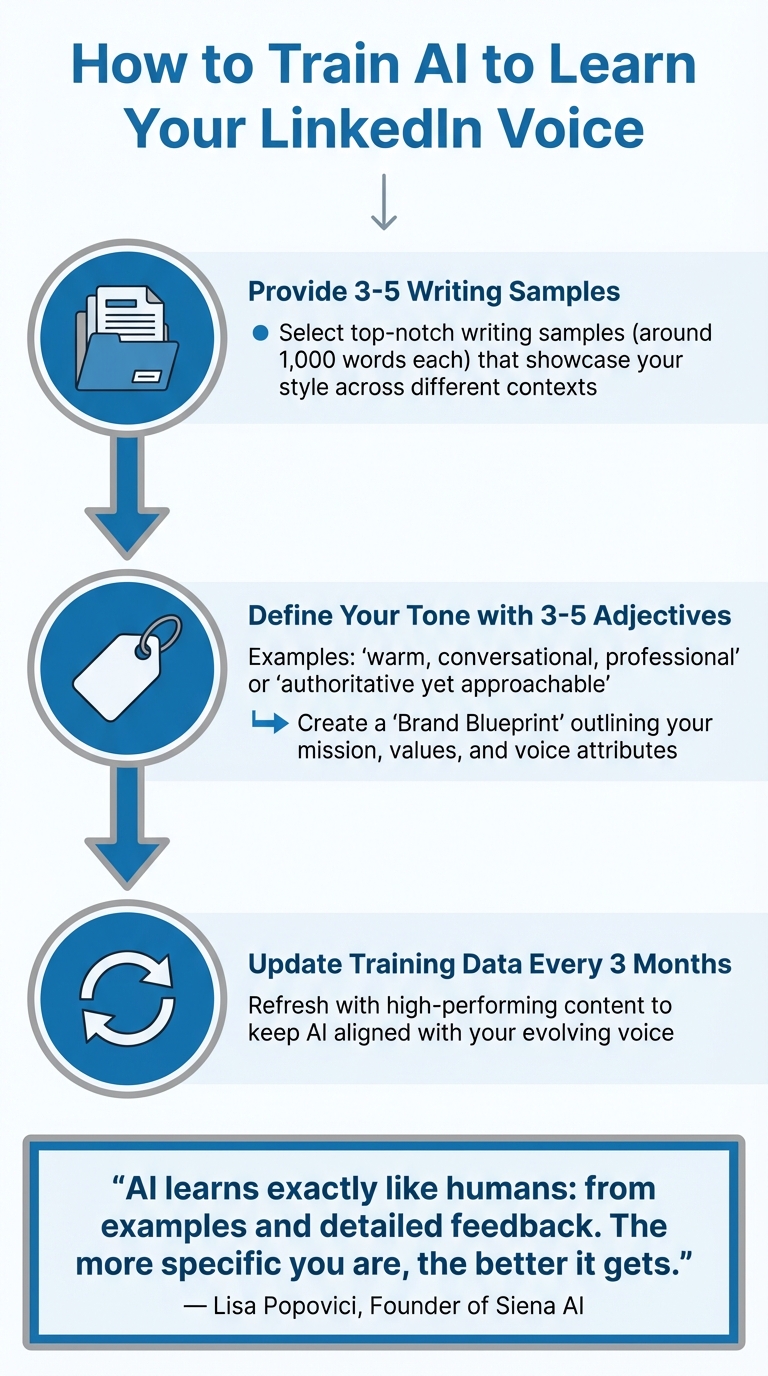
3-Step Process to Train AI on Your LinkedIn Writing Style
AI doesn’t replace your voice – it learns it. By analyzing your content, AI picks up on your tone, sentence patterns, vocabulary, and even your quirks. To get started, select 3–5 top-notch writing samples (around 1,000 words each) that showcase your style across different contexts.
It also helps to create a detailed "Brand Blueprint", which acts as a style guide. This should outline your mission, values, and 3–5 adjectives that describe your voice (e.g., "authoritative yet approachable"). As Lisa Popovici, Founder of Siena AI, explains:
"AI learns exactly like humans: from examples and detailed feedback. The more specific you are, the better it gets."
Teaching AI to Learn Your Voice
Training AI to write like you isn’t just about uploading a few posts. You’ll need to document what makes your writing distinct – things like your favorite transitions, how you use rhetorical questions, or the way you structure arguments. For instance, in May 2024, content marketing expert Erika Heald used GPT-4o to define a brand voice for her gluten-free blog. She prompted the AI to act as an "experienced content marketer" and create a voice chart with specific attributes, dos, and don’ts.
Once you’ve provided your samples, ask the AI to summarize your writing style in bullet points. This is a great way to check if it’s on the right track. If the tone feels too formal or doesn’t match your conversational style, give immediate feedback. As Sebastian Kinzlinger, Founder of ContentIn, points out:
"The AI gets better at your unique style with each piece of content you create together. It’s a team effort that improves over time."
Your voice isn’t static – it evolves as your business grows. To ensure the AI stays aligned with your current goals, update your training samples every three months with fresh, high-performing content.
Once your voice is fully defined, it’s time to let AI help with automating your content creation and scheduling.
Automating Post Creation and Scheduling
After the AI understands your voice, it can take on tasks like drafting and scheduling LinkedIn posts. Tools like Typoro use structured prompts that include six key elements – Task, Context, Example, Persona, Format, and Tone – to generate posts that sound like you. For instance, instead of simply asking for "a LinkedIn post", you could prompt: "Write a 150-word LinkedIn post as a tech founder sharing a lesson from a failed product launch, using a conversational tone with bullet points for readability."
This level of detail ensures the AI’s output aligns with your style while saving you time. In 2025, productivity expert Tiago Forte trained AI using three of his top articles – "The PARA Method" (2,000 words), "Building a Second Brain" (4,500 words), and "How To Take Smart Notes" (7,000 words). The result? Consistent, on-brand content that barely needed editing.
Automation also helps maintain consistency, which is essential for building an audience. With 57% of B2B companies already using AI for content creation, tools like Typoro allow founders to batch-create and schedule posts for optimal times. This ensures your audience sees your content when it matters most, keeping your voice active and authentic while freeing you up to focus on strategy.
Using Feedback to Improve AI Outputs
AI-generated drafts are rarely perfect on the first try. The key to success lies in refining these drafts with clear, specific feedback. Think of AI as a junior writer – it improves when you point out what’s off, whether it’s "too jargon-heavy", "missing personal storytelling", or "the hook isn’t engaging enough".
Lindsay Hope, an AI and Email Strategist, emphasizes:
"AI copy performs best when it’s tweaked with the human touch. You still have to tie any writing back to a human."
One effective way to review drafts is to read them aloud. If a sentence feels awkward or unnatural, it likely needs a rewrite. Brand Voice Strategist Justin Blackman notes:
"With clarification on your approach, views, and opinion, it gravitates toward the right style with fleshed-out ideas that are about 83% publishable as is."
This feedback loop is what makes AI a powerful tool. The more you refine the process, the less editing you’ll need over time. As your brand evolves, this iterative approach ensures your content stays dynamic while maintaining a consistent voice. And while AI can handle much of the heavy lifting, the human touch is what keeps your content genuine and relatable.
Typoro Features for Voice Development
Typoro is designed to help founders turn their scattered thoughts into polished LinkedIn posts while keeping their voice intact. By blending AI-driven writing with scheduling and analytics, the platform simplifies content creation. Co-Founder Pete Callaghan shared his motivation:
"I created Typoro to solve my own problem – turning scattered ideas into polished LinkedIn posts that grow my personal brand and drive engagement."
Here’s how Typoro’s features bring this vision to life.
AI Post Writing and Voice Matching
Typoro’s AI analyzes your previous writing to learn your unique tone, ensuring the posts it generates sound like they’re coming directly from you. Instead of starting from scratch every time, you can batch-create content for an entire month, keeping your messaging consistent.
To guide the AI, define 3–5 content pillars – such as thought leadership, industry insights, or company updates. This approach ensures your posts stay focused on your core themes. When reviewing drafts, use the "edit-first" strategy: choose the version that feels closest to your natural voice, then personalize it with anecdotes or examples from your own experiences. For LinkedIn, posts between 600–700 characters tend to perform best, and Typoro’s AI drafts content with this in mind.
LinkedIn Scheduling and Optimization
Once your posts are ready, Typoro handles scheduling, ensuring they go live at peak engagement times – typically Tuesday through Thursday between 9:00 AM and 11:00 AM. This feature ensures your audience sees your posts when they’re most active.
Founder Kieran Ball highlights the convenience:
"Typoro makes it easier to be a consistent presence on LinkedIn"
This scheduling tool is a game-changer for busy founders. You can batch-create content during focused sessions, and Typoro takes care of maintaining your posting schedule, freeing you to focus on other priorities.
Performance Tracking and Audience Insights
Typoro’s dashboard tracks key metrics like follower growth, post frequency, and engagement. By analyzing which posts resonate most with your audience, it helps you refine your approach. Audience insights include demographic breakdowns and organic share data, so you know exactly who’s engaging with your content.
Andrew Speer, Founder of Two Cores, shared his experience:
"Typoro takes my raw ideas and transforms them into polished, engaging posts that truly resonate on LinkedIn. It’s like having a personal editor and strategist rolled into one."
Beyond surface-level analytics, Typoro’s "post history" feature allows you to revisit and build on your best-performing content. This creates a system where your ideas evolve over time, helping you fine-tune your voice and strategy. It’s not just about individual posts – it’s about creating a lasting, impactful presence on LinkedIn.
| Plan | Price | AI Words | LinkedIn Users | Key Features |
|---|---|---|---|---|
| Creator | $19/month | 20K | 1 | Unlimited scheduling, Audience Insights |
| Growth | $39/month | 70K | 3 | Team collaboration, Audience Insights |
| Scale | $99/month | Unlimited | 10 | Team collaboration, Audience Insights |
Annual subscriptions save 20%.
sbb-itb-1b818d9
How to Maintain Voice Consistency
Keeping a consistent voice on LinkedIn while using AI can be tricky. Think of AI as a junior writer – it needs clear directions to reflect your style. Without this guidance, it often defaults to bland or overly generic language that lacks your personal touch.
Using AI to Adjust Tone Without Losing Authenticity
AI can help fine-tune your tone for different audiences or trending topics, but it doesn’t truly understand your perspective. As brand voice strategist Justin Blackman explains:
"The biggest limitation of AI copywriting is that even if you can get it to write like you, it can’t think like you. So it’s on you to make sure it knows your perspective."
Start by creating a "Say This, Not That" guide to outline preferred language and avoid overused buzzwords. For instance, if terms like "synergy" or "disrupt" don’t align with your style, make sure the AI avoids them. Identify 3–5 key personality traits (like "approachable" or "analytical") that define your voice. You can also include specific phrases or transitions you use often, such as "Here’s the deal…"
When reviewing AI-generated drafts, try the "Read Aloud Test." If the flow feels awkward or unnatural, tweak it to match your usual rhythm. Beyond tone adjustments, maintaining a regular posting schedule helps reinforce your brand voice.
Scheduling and Batch-Creation for Consistency
Consistency isn’t just about how you sound – it’s also about showing up regularly. Batch-create content for a week or even a month, and use tools like Typoro to schedule posts during peak engagement times. This approach ensures your content stays cohesive and reduces the daily pressure of creating new material.
Pairing scheduled posts with ongoing voice refinement helps maintain a steady rhythm. This complements earlier strategies for training AI iteratively, ensuring your posts reflect your unique style.
Fine-Tuning Voice Through Analytics
Evaluate AI-generated posts weekly against your style guide and track their engagement. A dip in metrics might signal that the AI’s tone has strayed from what resonates with your audience. Update the AI’s training data every quarter, using top-performing posts to keep its output aligned with your evolving voice. As Sebastian Kinzlinger, Founder of ContentIn, points out:
"The AI gets better at your unique style with each piece of content you create together. It’s a team effort that improves over time."
If the AI’s tone starts to drift, provide specific feedback to bring it back in line. This ongoing process ensures your voice remains sharp and consistent, no matter how much content you produce.
Measuring the Success of Your AI-Built LinkedIn Voice
Once you’ve crafted your AI-driven LinkedIn voice, the next step is to measure its impact. Don’t just focus on surface-level metrics like total likes – they can be misleading. The real question is whether your content is sparking meaningful engagement and connecting with the right audience.
Key Metrics to Track
Profile views are a great starting point. They show whether your content is compelling enough to make people want to learn more about you. Dive deeper into the demographics of your viewers – are they decision-makers, potential collaborators, or prospects? Or are they mostly competitors? This helps you assess whether you’re reaching the right crowd.
Another valuable metric is search appearances, which tells you how often your profile appears in LinkedIn searches. This reflects how well your voice helps you get discovered organically, a key sign of growing visibility.
When it comes to engagement, look beyond just likes and comments. Engagement rate (likes, comments, shares divided by impressions) reveals how well your content resonates. A particularly insightful metric is the save-to-like ratio (Saves ÷ Impressions × 100). A high save rate indicates your content is seen as valuable and worth revisiting, rather than just prompting quick reactions.
Don’t overlook qualitative feedback either. Which posts are sparking direct messages or leading to partnership opportunities? As Growth Terminal puts it:
"Analytics aren’t about vanity metrics – they’re about feedback."
To refine your strategy, set aside 15 minutes every Friday to review your top three posts from the week. Look for actionable insights you can apply to the next seven days. Pay attention to patterns – what topics, tones, or formats seem to resonate most with your audience? This kind of focused review will help you continuously improve your LinkedIn voice.
Typoro Plans and Analytics Features
Typoro makes tracking your AI-built LinkedIn voice simple with its built-in LinkedIn Audience Insights. Here’s a breakdown of their plans:
- Creator Plan ($19/month): Perfect for solopreneurs, this plan includes analytics, 20K AI-generated words, and 30 Agent Runs per month.
- Growth Plan ($39/month): Designed for teams managing up to three LinkedIn users, it offers 70K AI words and 100 Agent Runs monthly.
- Scale Plan ($99/month): Built for larger teams, this plan removes word limits entirely and includes 1K Agent Runs for managing up to 10 LinkedIn accounts.
All plans come with unlimited scheduling and team collaboration tools, so you can fine-tune your strategy without juggling multiple platforms.
| Plan | Price | LinkedIn Users | AI Words | Agent Runs | Analytics |
|---|---|---|---|---|---|
| Creator | $19/month | 1 | 20K | 30 | LinkedIn Audience Insights |
| Growth | $39/month | 3 | 70K | 100 | LinkedIn Audience Insights |
| Scale | $99/month | 10 | Unlimited | 1K | LinkedIn Audience Insights |
With Typoro, you have the tools to analyze and refine your content strategy, ensuring your LinkedIn voice continues to evolve and deliver results.
Conclusion
Developing a strong presence on LinkedIn doesn’t have to mean dedicating hours every day to writing posts from scratch. Tools like Typoro make it easier for founders to maintain consistent and engaging communication without the heavy time commitment. By analyzing your best writing samples, these tools adapt to your unique tone, rhythm, and vocabulary, allowing you to create content that feels authentically yours – without the daily grind.
The numbers speak for themselves. Founders who embrace AI-driven content strategies report an 85% reduction in time spent on content creation and a 137% boost in post engagement. These tools don’t replace your voice – they amplify it. As Sebastian Kinzlinger, Founder of ContentIn, explains:
"The AI gets better at your unique style with each piece of content you create together. It’s a team effort that improves over time".
Beyond saving time, this approach helps lay the groundwork for deeper connections and stronger engagement. With Typoro’s all-in-one platform, you can batch-create content, schedule posts for maximum impact, and track performance – all in just 90 minutes. And with pricing options tailored for founders at every stage, building and refining your LinkedIn presence has never been more manageable.
FAQs
How can AI tools like Typoro help me create a consistent LinkedIn voice?
AI tools such as Typoro simplify the process of maintaining a consistent voice on LinkedIn. By analyzing your previous posts, Typoro learns your tone, writing style, and frequently used phrases. With this information, it can generate, schedule, and refine new posts that align seamlessly with your personal brand.
Beyond just content creation, Typoro offers performance insights and audience analytics. These features allow you to adjust your strategy for better engagement, making it a practical tool for professionals who want to expand their LinkedIn presence without losing that personal touch.
How can I train AI to match my LinkedIn writing style?
To make AI reflect your LinkedIn voice, start by gathering a handful of your top-performing posts that best capture your tone and style. Look for patterns – what kind of tone do you use? Are there specific phrases or sentence structures that stand out? From this analysis, craft a simple style guide using a few descriptive words like "friendly," "professional," or "conversational." Include examples of what works well and what to avoid.
Next, upload your style guide and sample posts to an AI platform like Typoro, which supports brand voice customization. When generating content, use clear and consistent prompts to guide the AI toward your preferred style. It’s also important to review and edit the AI’s drafts regularly, offering feedback to fine-tune its results. Refreshing your training data every few months will ensure the AI stays aligned with your evolving personal brand. Following these steps can help you save time while keeping your LinkedIn voice consistent and engaging.
How can I track the performance of AI-generated LinkedIn posts?
To measure how well your AI-generated LinkedIn content is performing, dive into LinkedIn’s post analytics. Focus on key metrics like impressions, reactions, comments, shares, and link clicks. Want to calculate your engagement rate? Take the total interactions, divide it by impressions, and then multiply by 100.
Don’t stop there – track profile views, click-through rates, and any direct leads, such as messages or demo requests sparked by your posts. These metrics offer valuable insights into what clicks with your audience and can guide you as you tweak and improve your LinkedIn strategy over time.
Related Blog Posts

 Kieran Ball - Founder
"Typoro makes it easier to be a consistent presence on LinkedIn"
The LinkedIn Ghostwriter for Busy Founders.
Typoro’s AI agents think, research and write weekly LinkedIn posts that help grow your personal brand.
