How Founders Use AI for Team Content Creation

Founders are leveraging AI tools to simplify LinkedIn content creation, saving time and boosting engagement. Here’s how:
- AI Efficiency: AI helps generate ideas, draft posts, and schedule them, cutting content creation time from hours to minutes.
- Improved Engagement: AI-assisted posts show a median engagement rate of 6.85%, higher than non-AI posts at 6.22%.
- Balanced Workflows: While AI handles repetitive tasks, founders add personal insights, ensuring quality and authenticity.
- Team Collaboration: Tools like Typoro streamline workflows, offering shared workspaces, audience insights, and scheduling features.
- Challenges: AI can produce errors or robotic tones, but with proper editing, these issues can be mitigated.
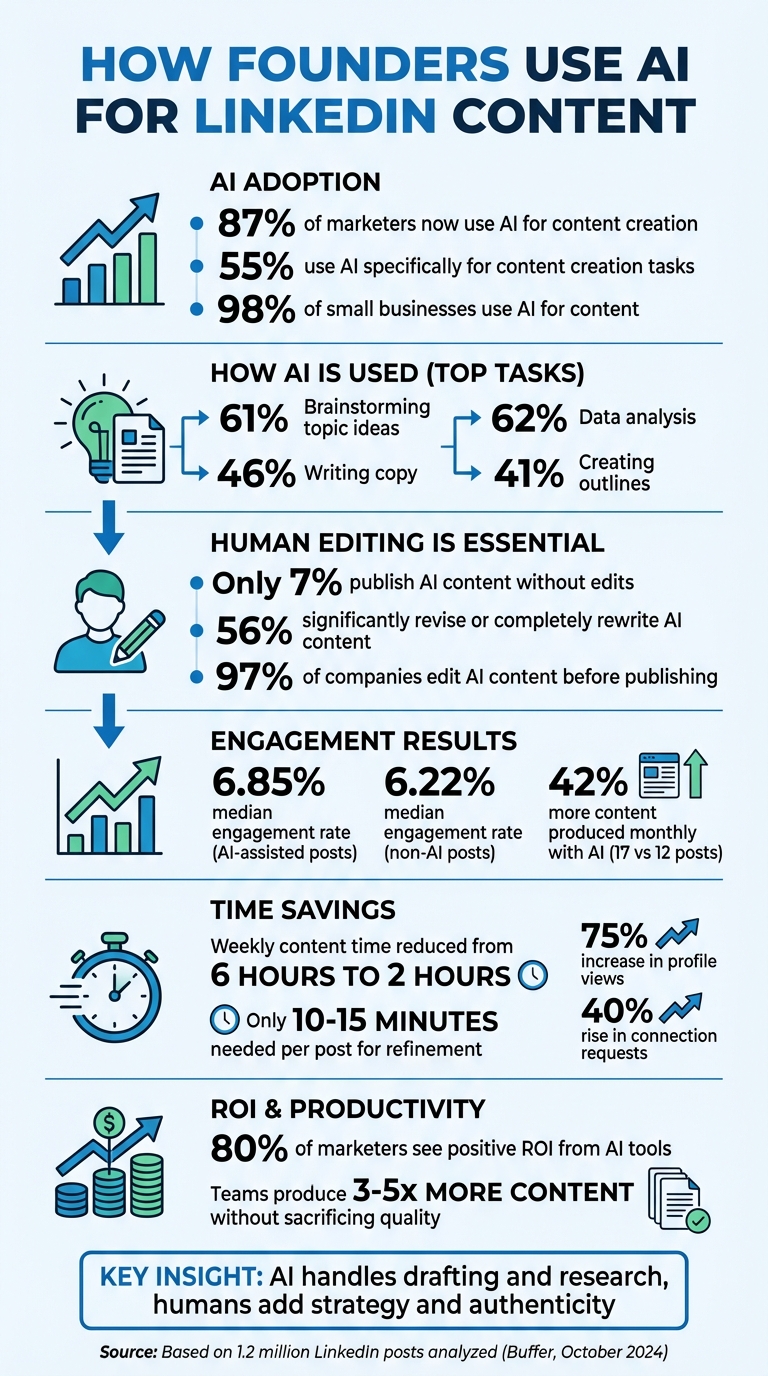
AI Content Creation Statistics: How Founders Use AI for LinkedIn
Watch Me Use AI to Create 30 Days of Viral LinkedIn Posts
Research Data: How Founders Use AI for LinkedIn Content
Recent data sheds light on how founders are leveraging AI to enhance their LinkedIn content strategies. The findings highlight specific patterns in how AI is integrated into their workflows, focusing on creativity, efficiency, and engagement.
Common Ways Founders Use AI
The numbers speak volumes: 87% of marketers now use AI to assist with content creation, and founders are at the forefront of this trend. AI is most commonly used for content creation, with 55% of marketers adopting it for this purpose. However, founders are not relying on AI for full automation – they’re using it strategically to complement their efforts.
Brainstorming takes the top spot, with 61% of marketers turning to AI for generating topic ideas. This helps overcome the dreaded blank screen. Founders also depend on AI for writing copy (46%), creating outlines (41%), and data analysis (62%) to better understand their audience. Essentially, AI handles the heavy lifting – research, initial drafts, and formatting – while founders focus on adding strategy and a personal touch.
Interestingly, only 7% of marketers publish AI-generated content without making edits. In contrast, 56% either significantly revise or completely rewrite AI-generated material. This "human-in-the-loop" approach ensures that the final output feels authentic and avoids the pitfalls of robotic, uninspired content.
These findings highlight how founders are creating efficient workflows that blend AI’s capabilities with their own expertise.
Typical Content Workflows
Founders who excel at LinkedIn content often follow a structured workflow. It starts with strategic ideation, where AI is used to quickly generate a month’s worth of content ideas centered around key business themes. This proactive approach shifts the mindset from scrambling for daily posts to having a clear, forward-looking plan.
The next step is accelerated drafting. With AI, creating a first draft takes minutes instead of hours. But the real magic happens afterward: founders dedicate 10–15 minutes to refining the draft, injecting their personal stories, fine-tuning the tone, and adding expert insights. This small but crucial effort ensures that the content resonates on a deeper level.
A study by Buffer in October 2024 analyzed 1.2 million LinkedIn posts and found that AI-assisted posts achieved a 6.85% median engagement rate, compared to 6.22% for posts created without AI. The key driver wasn’t just the use of AI – it was the ability to publish more frequently and consistently. Marketers using AI produce 42% more content monthly (17 posts versus 12), which directly boosts visibility and engagement through LinkedIn’s algorithm.
The final piece of the puzzle is proactive engagement. Savvy founders use AI to craft thought-provoking questions based on their posts and drop these into the comments immediately after publishing. This sparks conversations and signals activity to LinkedIn’s algorithm, helping their posts gain traction. It’s a small but impactful tactic that amplifies reach and engagement.
Team Roles in AI Content Workflows
Team Structures for Content Creation
Solo founders often rely on AI as a dependable partner for creating first drafts, helping them maintain a steady content flow while managing everything from strategy to final edits.
In founder-marketer setups, responsibilities are divided strategically. The founder steps into the role of "Editor-in-Chief", bringing a unique voice, personal anecdotes, and strategic direction to the table. Meanwhile, the marketing lead focuses on content strategy, creating topic roadmaps, and managing AI tools – turning high-level plans into actionable briefs.
Small content teams take a more specialized approach, assigning roles like AI prompt specialists, quality reviewers, and final approvers to streamline the process. This setup allows team members from various departments – sales, product management, or customer service – to draft initial content or case studies. Professional writers then refine these drafts into polished pieces. Teams that incorporate generative AI often see a dramatic increase in productivity, producing three to five times more high-quality content.
The success of such workflows lies in the balance between human creativity and AI efficiency.
"Artificial intelligence is most powerful when humans and machines collaborate." – Joe Pulizzi, Founder, Content Marketing Institute
Humans bring strategic vision, critical judgment, and authenticity to the process, while AI takes care of drafting and research tasks. Founders, in particular, contribute invaluable elements such as personal experiences, deep market knowledge, and strategic insights.
How Typoro Supports Team Collaboration

Typoro builds on these collaborative roles by addressing the real-world challenges founders face when scaling LinkedIn content. The platform offers shared workspaces where teams can store top-performing prompts and ensure a consistent brand voice. This eliminates the risk of fragmented messaging across posts.
Typoro’s AI drafting tools integrate smoothly into team workflows. For example, a marketing lead can set up the content calendar and strategy, while the founder adds personal insights and stories to AI-generated drafts. This seamless collaboration leads to stronger LinkedIn engagement and a unified brand presence.
Typoro’s pricing tiers cater to different team sizes and needs. The Creator plan ($19/month) is designed for solo founders, offering 1 LinkedIn user and 20,000 AI-generated words. The Growth plan ($39/month) supports small teams with up to 3 users and 70,000 AI words. For larger teams, the Scale plan ($99/month) provides access for up to 10 users with unlimited AI words. All plans include team collaboration tools, LinkedIn audience insights, and unlimited post scheduling, transforming AI into a comprehensive workflow solution.
sbb-itb-1b818d9
Benefits and Challenges of Using AI for Content
Measurable Benefits for Founders
AI-assisted LinkedIn posts have been shown to outperform purely human-written ones, achieving a median engagement rate of 6.85% compared to 6.22%. This edge comes from more frequent and consistent posting, which helps boost visibility through LinkedIn’s algorithm.
The time savings are just as important. In September 2025, Matthew Bulat cut his weekly content creation time from 6 hours to just 2 hours by using AI for brainstorming and drafting. He spent only 15 minutes per post fine-tuning the content, which led to a 75% increase in profile views, a 40% rise in inbound connection requests, and two qualified leads directly from post comments. Additionally, 80% of marketers report seeing a positive ROI when using generative AI tools for content writing. Automating routine tasks allows founders to stay consistent with their posting schedules, even during hectic periods, increasing their chances of reaching and engaging their audience. While these benefits are clear, they also introduce challenges that require careful consideration.
Common Problems and How to Solve Them
Despite the advantages, AI-generated content isn’t without its flaws. For example, 43% of marketers report issues with AI producing inaccurate information, and posts created entirely by AI tend to get 45% less engagement than those written by humans. The robotic tone and generic style that AI sometimes produces can even harm a founder’s personal brand.
The key is to treat AI as a helpful starting point rather than the final product. In fact, 97% of companies edit AI-generated content before publishing it. Founders should spend 10–15 minutes per post adding personal insights, double-checking facts, and refining the tone to ensure it feels genuine and aligns with their voice.
"Hallucination is a fact of life for LLMs… AI content will never be perfectly accurate, but neither is human-written content." – Ryan Law, Director of Content Marketing, Ahrefs
Data privacy is another pressing concern, with 41% of marketers identifying security risks as a barrier to AI adoption. Founders working with sensitive company data should set clear policies on what information can be shared with AI tools and always run plagiarism checks on drafts.
Pros and Cons Comparison
Weighing the benefits and drawbacks of AI in content creation provides a clearer picture of its trade-offs.
| Factor | Advantages | Disadvantages |
|---|---|---|
| Speed | Produces drafts quickly | Requires manual review and fact-checking |
| Consistency | Keeps posts regular during busy times | Risk of flooding feeds with low-value content |
| Originality | Suggests fresh ideas and angles | May lack originality without human input |
| Brand Fit | Can be trained to follow brand guidelines | Sounds robotic if left unedited |
| Engagement | Increased output leads to more connections | Pure AI posts see 45% less engagement |
| Accuracy | Summarizes large datasets efficiently | Prone to factual errors and hallucinations |
AI shines when it comes to handling repetitive tasks like brainstorming, outlining, and basic editing. However, the human touch is essential for adding strategic depth, emotional resonance, and authenticity. Founders who strike the right balance can triple their engagement while slashing their weekly content creation time from 6 hours to just 2 hours.
Practical Steps for Founders
Setting Up Team Collaboration
Break your workflow into six key phases: planning, research, drafting, personalization, publication, and review. This structure allows founders to streamline their processes, pinpoint where AI tools can make the biggest difference, and recognize where human expertise is still indispensable.
Assign specific roles to your team for clarity and efficiency. For example, designate an Editor-in-Chief to oversee strategy and maintain quality standards, a Managing Editor to handle scheduling and briefings, and other team members to focus on drafting and refining content.
Create a library of templates with standardized AI prompts tailored to different content types. Include examples of high-performing posts and style guidelines to fine-tune your AI tools. Platforms like Typoro offer collaboration features that cater to teams of various sizes. For instance:
- Creator plan: Supports 1 LinkedIn user
- Growth plan: Supports 3 users
- Scale plan: Supports up to 10 users
To enrich your content, use transcripts from meetings, client calls, and webinars. This approach ensures your material includes real insights instead of generic advice. Teams adopting this method have reported producing 3 to 5 times more content without compromising on quality.
Using Analytics to Improve Content
Once your workflow is set, analytics can help you fine-tune your strategy. Monitor key metrics like impressions, engagement quality, audience demographics, dwell time, and comment activity. These indicators not only help you convert views into leads but also allow you to refine distribution strategies by analyzing early performance – particularly within the first hour. Incorporating AI-driven engagement analysis has been shown to boost post reach by 200–300% in just three months.
Use Typoro to analyze your top-performing posts and uncover patterns. Compare content formats – such as text-only updates, carousels, and videos – to determine what resonates best with your audience. Typoro’s LinkedIn Audience Insights feature can further track metrics like audience demographics and engagement timing, helping you optimize future content based on actionable data.
AI can also help identify opportunities in older posts. For instance, posts with declining traffic or mismatched keywords can be updated or repurposed. Additionally, recurring themes in successful posts can be organized into "content pillars", which serve as a foundation for your long-term strategy.
What You Need Before Starting
Before diving into these strategies, make sure you have the right resources in place to support your content workflow. Three essentials to prioritize are: a Brand Voice Guide, a library of seed content, and clear editorial guardrails.
- Brand Voice Guide: Document your tone (e.g., professional or casual), style preferences, and visual elements. This helps ensure AI-generated content stays aligned with your personal or company brand.
- Seed Content Library: Gather examples of your best work – such as past successful posts, recorded presentations, or client testimonials. These serve as valuable references for AI tools, allowing them to produce content that reflects your unique voice rather than generic material.
- Editorial Guardrails: Define strict boundaries, such as avoiding fabricated quotes, invented data, or impersonating customers. With nearly 98% of small businesses now using AI for content creation, establishing clear guidelines ensures sensitive information remains protected.
To ensure ongoing success, conduct monthly performance reviews. Use these sessions to evaluate engagement metrics and adjust your brand voice or audience profiles based on what’s working. Start small by assigning AI simple tasks, then gradually scale up to more advanced roles like full draft creation. This step-by-step approach helps your team gain confidence and strike the right balance between automation and human creativity.
Conclusion
Recent data highlights how most marketers and small businesses are now using AI to simplify content creation tasks. These tools allow founders to draft a 500-word post in less than an hour and produce three to five times more content, all while maintaining quality.
The real game-changer isn’t about choosing between AI and human effort – it’s about combining the two effectively. When AI’s speed and efficiency meet human creativity and strategic thinking, the results can be transformative. AI takes care of brainstorming, research, and drafting, while founders add the personal touch and strategic depth needed to truly engage their audience.
Collaborative tools make this integration even smoother. For example, Typoro offers shared workspaces where teams can refine AI prompts, ensure brand voice consistency, and streamline approval workflows. Whether you’re a solo entrepreneur or part of a larger team, Typoro adapts to your needs, helping you create content that stays on message.
The impact of this approach is clear. In September 2025, Matthew Bulat cut his weekly LinkedIn time from six hours to just two, yet managed to triple his engagement and increase profile views by 75%. His secret? Using AI for efficiency and spending just 10–15 minutes per post to add a human touch. It’s a powerful example of how balancing automation with personal input can drive measurable growth.
Start by setting up workflows that delegate repetitive tasks to AI. This frees you up to focus on what only you can do – sharing your unique insights and leadership. With this strategy, LinkedIn can become a scalable tool for building your brand and growing your influence.
FAQs
How can founders make AI-generated LinkedIn posts feel authentic?
To make AI-generated LinkedIn posts feel genuine, founders should see AI as a partner rather than a substitute for their unique voice. AI can help brainstorm ideas, draft initial versions, and even analyze audience behavior. However, the magic happens when you step in to refine the content – adding personal stories, unique insights, and your own tone to ensure the post truly represents you.
Staying hands-on is crucial. Carefully review drafts to make sure they align with your brand and resonate with your audience. Keep an eye on engagement metrics to fine-tune your prompts and keep your content relevant. Tools like Typoro can simplify tasks like drafting and scheduling, but the heart of your posts – the part that builds trust and connection – comes from you.
What are the benefits of using AI for creating LinkedIn content?
Using AI for LinkedIn content creation can be a game-changer, offering time efficiency, scalability, and better engagement. With AI tools, busy founders can turn rough ideas into polished posts in just minutes, eliminating the hours typically spent drafting and editing. This means they can stay active on LinkedIn without sacrificing time for other essential tasks.
AI doesn’t just save time – it also elevates content quality. By offering data-backed suggestions like the best hooks, relevant hashtags, and ideal posting times, these tools help ensure posts resonate with the audience. Some even generate visuals to keep a cohesive brand aesthetic. Founders using AI-guided strategies have reported impressive results, including up to three times more interactions in just one month.
For those looking for a seamless solution, platforms like Typoro bring everything together. From AI-generated drafts to scheduling, analytics, and audience insights, these tools simplify the entire process, making LinkedIn content creation not only easier but also more aligned with business growth objectives.
How can AI tools like Typoro help teams collaborate on LinkedIn content creation?
AI tools like Typoro make LinkedIn content creation a breeze for teams by simplifying collaboration. With Typoro, draft posts are generated in seconds, giving teams a shared starting point to refine, approve, and schedule content – all from one intuitive dashboard. Say goodbye to juggling email attachments and struggling with version control. Plus, handy features like automatic trimming ensure your posts always meet LinkedIn’s character limits.
What sets Typoro apart is its built-in analytics and audience insights. Teams can easily pinpoint what works best – whether it’s specific hooks, posting times, or other strategies that boost engagement. By bringing drafts, performance data, and scheduling together in one place, Typoro turns content creation into a seamless, data-driven team effort. The result? A more efficient workflow and a consistent, polished brand voice.
Related Blog Posts

 Kieran Ball - Founder
"Typoro makes it easier to be a consistent presence on LinkedIn"
The LinkedIn Ghostwriter for Busy Founders.
Typoro’s AI agents think, research and write weekly LinkedIn posts that help grow your personal brand.
