Top Social Proof Strategies for LinkedIn Founders
Social proof can turn your LinkedIn profile into a magnet for clients, investors, and talent. Here’s how:
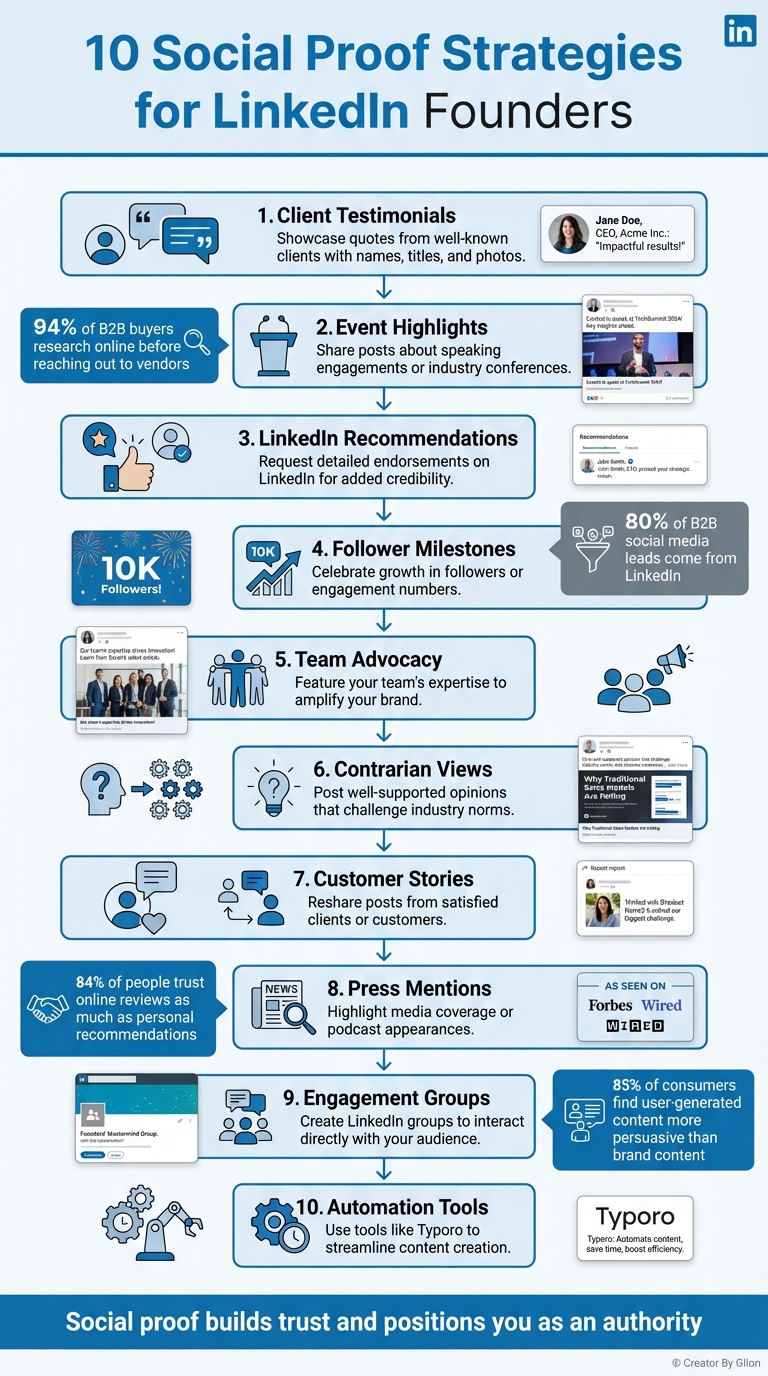
- Client Testimonials: Showcase quotes from well-known clients with names, titles, and photos.
- Event Highlights: Share posts about speaking engagements or industry conferences.
- LinkedIn Recommendations: Request detailed endorsements on LinkedIn for added credibility.
- Follower Milestones: Celebrate growth in followers or engagement numbers.
- Team Advocacy: Feature your team’s expertise to amplify your brand.
- Contrarian Views: Post well-supported opinions that challenge industry norms.
- Customer Stories: Reshare posts from satisfied clients or customers.
- Press Mentions: Highlight media coverage or podcast appearances.
- Engagement Groups: Create LinkedIn groups to interact directly with your audience.
- Automation Tools: Use tools like Typoro to streamline content creation.
Key Insight: Social proof builds trust and positions you as an authority. Use testimonials, recommendations, and content that shows others value your expertise.
10 Social Proof Strategies for LinkedIn Founders
1. Use Testimonials from Well-Known Clients
Credibility Boost
When a prominent client vouches for your work, it sends a strong message to potential customers: your services are trusted by respected professionals. This is particularly impactful in B2B settings, where decision-makers often rely on endorsements to validate a service’s reputation within their industry. Whether it’s a Fortune 500 executive or the founder of a rising startup, a testimonial with clear attribution – complete with a headshot, name, and title – creates a level of authenticity that’s hard to dispute. These personalized elements make the endorsement feel genuine and relatable, offering a powerful layer of credibility for your business.
Ease of Implementation
Collecting testimonials doesn’t have to be a complicated process. Reach out to your key clients directly and ask for short, meaningful quotes about their experience. If they’ve already participated in case studies, you can repurpose that material into concise testimonials. To encourage participation, you might consider offering modest perks like a 10–20% discount, free upgrades, or early access to new features. Just be cautious – any incentive should feel like a token of appreciation rather than a bribe to ensure the testimonial remains sincere and trustworthy.
Relevance to LinkedIn Audience
LinkedIn is all about professionalism, so your testimonials need to reflect that. Focus on stories that showcase how your services helped clients overcome specific business challenges. Avoid generic praise and instead craft narratives that resonate with professionals facing similar hurdles. This approach not only connects with your audience but also positions your clients as thought leaders within their industries. Share these testimonials strategically – on your LinkedIn posts, your Company Page, or even in targeted ad campaigns. By weaving these stories into your LinkedIn presence, you strengthen your authority and align perfectly with the platform’s professional tone.
2. Post About Speaking Events and Conference Appearances
Building Credibility
Speaking at industry events is a powerful way to showcase your expertise. It’s like getting a stamp of approval from a respected third party, which instantly enhances your reputation. As James Reynolds, Founder of SEO Sherpa, says:
Even if you feel like an impostor, you probably know more than 99% of the people in the room. This, and the public speaking, sharing what you know positions you as the expert.
The moment you step onto that stage, people see you as an authority. It’s the halo effect in action – they assume you’re highly knowledgeable simply because you were chosen to speak. This perception is especially valuable on LinkedIn, where a staggering 94% of B2B buyers research online before reaching out to vendors.
Driving Engagement
Posts about speaking engagements can be goldmines for content. Use recorded sessions to create short video clips, carousels, or posts that highlight key moments. If you’ve shared a stage with well-known speakers, mention it – it boosts your credibility by association. After an event, don’t hesitate to ask organizers, “Do you know anyone else who hosts similar events?” This simple question can lead to future speaking opportunities. And yes, it’s okay to crop photos strategically to make the room look more packed.
Getting Started
If you’re new to public speaking, start small. Look for local events on platforms like Meetup or Eventbrite. Pitch yourself to organizers with a polished one-sheet PDF that includes your bio, key topics, and any presentation clips you have. No experience? No problem. Begin with podcast appearances – they’re great for building your portfolio and can help you secure bigger speaking gigs down the line. Even small audiences can open doors to larger stages.
Resonating with the LinkedIn Crowd
LinkedIn is where professionals go to find thought leadership – and speaking posts align perfectly with that expectation. With 80% of B2B social media leads coming from LinkedIn, sharing these experiences supports the decision-making process of potential clients. Pin your best-performing speaking posts to the Featured section of your profile, and include links to recorded presentations in the Experience section. A simple “thank you” to event organizers or your audience can go a long way in showing gratitude. This kind of authenticity fits right into LinkedIn’s professional yet personal vibe, where behind-the-scenes glimpses and genuine connections make a lasting impact.
HOW TO USE LINKEDIN TO BUILD TRUST AND SOCIAL PROOF | #AskNat
3. Display LinkedIn Endorsements and Recommendations
After delivering a speaking engagement or completing a project, endorsements and recommendations on LinkedIn can significantly enhance your professional credibility by providing instant, verifiable social proof.
Why They Matter
LinkedIn recommendations hold more weight than the typical testimonials you might feature on a website. Why? Because they’re instantly verifiable. Readers can click on the reviewer’s profile and confirm their credentials. As Melonie Dodaro, a LinkedIn and Social Selling Expert, puts it:
LinkedIn recommendations are often more powerful than written testimonials on your website, because readers can authenticate the author of a LinkedIn recommendation by clicking on their profile then and there.
Endorsements, especially when they hit the "99+" mark for a specific skill, create a powerful bandwagon effect. On the other hand, recommendations take more effort to write, which makes them an even stronger form of social proof. They’re not just a casual thumbs-up – they’re a detailed vote of confidence.
Making the Process Simple
Getting endorsements is relatively easy. Start by endorsing your peers – it often encourages them to reciprocate. If someone shares positive feedback about your work, politely ask if they’d be willing to write a recommendation for you on LinkedIn. To make it even easier, personalize your request and, if appropriate, provide them with a draft they can tweak. Dodaro advises against seeking endorsements from people who can’t genuinely speak to your skills or experience. These small but meaningful steps ensure your endorsements and recommendations feel authentic and resonate with LinkedIn’s professional audience.
Tailoring Your Profile for Maximum Impact
LinkedIn is a key player in decision-making, with 52% of consumers identifying it as the most influential platform during their research process. This makes endorsements and recommendations essential for building trust with potential clients and partners. To make the most of these features, rearrange your skills section so the three most endorsed or relevant skills appear at the top. Combined with strong recommendations, this simple tweak can leave a lasting impression on your audience.
4. Celebrate Follower Growth and Engagement Numbers
Credibility Boost
Highlighting your growth metrics can do wonders for your credibility, especially when paired with endorsements and event appearances. Sharing milestones like follower counts or engagement stats on LinkedIn taps into the "wisdom of the crowd." Big numbers send a clear message to clients and partners: your insights are valued. As Robert Cialdini, author of Influence: The Psychology of Persuasion, puts it:
We view a behavior as more correct in a given situation to the degree that we see others performing it.
A large follower count creates a "halo effect", signaling expertise and authority. For emerging entrepreneurs, this can be a game-changer. Take Aarushi Singh, for example. By October 2023, she had grown her LinkedIn following to 30,000 and scaled her consulting business from scratch to $100,000 in annual revenue. Numbers like these show your audience that you’re making an impact and that your expertise is worth their attention.
Relevance to LinkedIn Audience
On LinkedIn, numbers speak louder than you might expect. A whopping 80% of all B2B social media leads come from LinkedIn. When potential clients or collaborators visit your profile, they’re silently evaluating your credibility. Growth and engagement metrics provide instant proof of your track record. For instance, Adam Robinson, a founder, generated 21 million views on LinkedIn in 2024, which helped propel his company to $4 million in Annual Recurring Revenue (ARR). These visible successes make it easier for others to trust your expertise.
Ease of Implementation
Celebrating milestones doesn’t have to be a production-heavy task. The trick lies in how you frame it – express gratitude rather than self-promotion. Tesla nailed this approach in early 2017 when they won Germany’s Best Car Award. Instead of boasting, they thanked the 124,000 voters who made it possible. You can do the same with a simple yet meaningful message, like: "Grateful for the support of 15,000 followers." This not only highlights your achievement but also fosters a sense of community. And as you’ll see in the next strategy, this complements showcasing your expertise through team advocacy.
5. Feature Your Team Members as Brand Advocates
After leveraging client testimonials and event endorsements, take it a step further by showcasing your team as advocates for your brand. This strategy not only strengthens your LinkedIn presence but also highlights the collective expertise within your organization.
Building Trust and Credibility
Your team can be instrumental in building trust on LinkedIn. When they share their knowledge and experiences, it sends a clear message: your company thrives on a collective effort, not just one individual. It’s worth noting that 85% of consumers find user-generated content (UGC) more persuasive than content created directly by brands. Posts from employees act as authentic UGC, aligning with your brand’s mission. As Kirsti Lang from Buffer puts it:
Empowering employees to build their personal brands on LinkedIn… is a win-win for both employee and business.
When your team members establish themselves as experts, it enhances your company’s reputation. This collective expertise creates a strong "Expert" image, building confidence among potential clients and reinforcing your brand’s credibility.
Expanding Your Reach
Your team members can significantly increase your visibility. Each person brings their own network and perspective, which helps broaden your audience. Considering that 94% of B2B buyers research online before reaching out to a vendor, having multiple voices from your organization sharing insights can make a big difference. This approach complements client testimonials and endorsements, presenting a well-rounded image of expertise that resonates with a research-driven audience.
How to Get Started
Getting your team involved doesn’t have to be complicated. Start by scheduling a weekly 30–45 minute content session with team members. Use 7–10 targeted questions to draw out their insights, stories, and strategies. Tools like Riverside or Descript can help you record and transcribe these sessions, ensuring their unique voices are preserved. If resources are limited, begin small – feature team member quotes or add their headshots alongside testimonials for a personal touch. The key is to make it a win-win: as team members grow their professional presence, they’ll be more motivated to contribute regularly.
sbb-itb-1b818d9
6. Share Contrarian Views with Supporting Evidence
Credibility Boost
Taking a stand against widely accepted industry beliefs can set you apart as a leader. By challenging common assumptions and backing your arguments with solid, evidence-based insights, you not only showcase your expertise but also build credibility on platforms like LinkedIn. For instance, while 96% of B2B marketers assume the primary impact of ad campaigns occurs within two weeks, the "95-5 Rule" suggests otherwise – 95% of potential buyers are not actively in-market at any given time. Ty Heath, Director of Market Engagement at LinkedIn, sheds light on this misconception:
"The myth that ads work by moving buyers ‘in-market’ is most commonly expressed through the sales funnel. But ads don’t work by moving people down the funnel. In fact, ads work by reaching buyers who aren’t even in the funnel yet."
When you challenge the status quo with well-supported arguments, you tap into the halo effect. If your audience views you as an expert in one area, they’re more likely to trust your insights across the board.
Engagement Potential
Questioning trends or exposing flawed industry norms can grab attention and spark meaningful discussions. Today’s LinkedIn users value authenticity and transparency, and marketers often struggle to generate fresh content ideas – 25% cite this as their biggest challenge. Offering a contrarian perspective, such as a "villain" story that critiques outdated practices, can make your content stand out. However, it’s important to aim for thoughtful discussions rather than stirring controversy for its own sake. This approach not only increases engagement but also strengthens your overall strategy for building trust and credibility.
Ease of Implementation
In your weekly 30–45 minute content brainstorming session, ask yourself questions like, "What industry beliefs do I strongly disagree with?" or "What recent trends seem overhyped or flawed?" Focus on topics that align with your expertise and resonate with your audience’s challenges. As Alexander Estner and Ivan Peric from MRR Unlocked explain:
"Great thought leadership content educates, challenges assumptions, and provides actionable insights."
Consistency is key – regularly share insights that encourage critical thinking. Instead of chasing viral moments, prioritize delivering valuable content that addresses your audience’s needs and positions you as a thought leader.
7. Repost Content from Your Customers and Followers
Building Trust Through Customer Voices
Reposting content from your customers is a powerful way to strengthen your credibility. When people share their experiences with your product or service, their words carry far more weight than traditional marketing messages. In fact, 84% of people trust online reviews as much as personal recommendations from friends or family. By sharing this user-generated content, you’re showcasing genuine stories that highlight your value. As Robert Cialdini, author of Influence: The Psychology of Persuasion, puts it:
We view a behavior as more correct in a given situation to the degree that we see others performing it.
This kind of validation not only builds trust but also encourages others to engage with your brand.
Driving Engagement and Strengthening Relationships
Sharing customer success stories isn’t just about showcasing your brand – it’s also a way to deepen engagement. When you highlight a customer’s accomplishments, you’re not only boosting their profile but also creating a sense of goodwill. This often leads to stronger connections and inspires more customers to share their experiences. The data supports this: customers are willing to spend up to 49% more with businesses that actively respond to reviews and social mentions. By interacting with and celebrating your customers, you create a cycle of positivity that benefits everyone.
How to Make It Happen
Reposting user-generated content is surprisingly simple and highly effective. Start by monitoring platforms like LinkedIn for mentions of your brand. When you spot a great post, reshare it and make sure to tag the creator. To make this process even easier, create a branded hashtag that customers can use to share their experiences. This helps you keep track of content while encouraging participation.
Want to encourage more posts? Offer small perks like a 10–20% discount or early access to new features. Just remember to always ask for permission before sharing photos or videos. And if you come across negative feedback, address it openly and honestly – it’s a great way to show transparency and build trust.
8. Share Press Coverage and Podcast Guest Spots
Credibility Boost
Press coverage and podcast appearances can significantly strengthen your LinkedIn presence. When you’re featured by a trusted outlet, their credibility rubs off on your personal brand. This phenomenon, known as the "Halo Effect", means that being associated with a respected source makes others view you in a more positive light. These features act as expert social proof, essentially certifying you as an authority in your field. For B2B prospects on LinkedIn, this kind of third-party validation is a powerful trust builder. Media mentions not only reinforce your expertise but also elevate your reputation in a way that self-promotion simply can’t match.
Ease of Implementation
Sharing press or podcast features on LinkedIn is straightforward and highly effective, even if you’re working with limited resources. Once you’ve secured the feature, all that’s left is to share it. Keep your tone humble with phrases like "Grateful for the mention" or "Honored to be featured", which highlight your achievement without coming across as overly self-promotional. Tagging the publication or podcast host not only shows gratitude but can also expand the reach of your post. To get even more mileage, repurpose key moments from these appearances into LinkedIn posts, sales materials, or digital ads.
Relevance to LinkedIn Audience
When sharing media appearances, remember that LinkedIn audiences appreciate authenticity and educational value over blatant self-promotion. Focus on quality over quantity – a single feature in a respected industry publication carries more weight than multiple mentions in less relevant outlets. Tailor your posts to align with your network’s professional interests, and consider inviting featured experts for LinkedIn Live sessions or account takeovers. These collaborative efforts not only expand your reach but also provide additional value to your audience.
9. Create Engagement Groups with Your Target Audience
Boosting Credibility
Engagement groups on LinkedIn are a powerful way to showcase real-time social proof. When industry peers interact with your content, it sends a clear message: your expertise is recognized and valued. This is especially important in B2B, where 94% of buyers conduct thorough online research before reaching out to a vendor. Seeing trusted colleagues engage with your posts can give prospects the confidence they need to take the next step. High engagement from respected peers not only validates your authority but also makes your content stand out as worth their time.
Unlocking Engagement Opportunities
LinkedIn dominates the B2B space, with 80% of all B2B social media leads coming through the platform and 93% of B2B marketers using it for content marketing. Engagement groups take this a step further by turning leads into active opportunities. By engaging strategically with ideal clients and partners, you ensure your content appears in the right feeds. Conversations within these groups often surface in LinkedIn’s main feed, keeping your brand visible and relevant.
"Push content builds visibility. Pull strategy creates opportunity." – Paula Graziani, Content & Storytelling Strategist
The next step? Setting up your engagement group efficiently.
Getting Started Easily
Creating a LinkedIn engagement group doesn’t have to be complicated. Here’s how to get it right:
- Share 3–4 quality posts before inviting members, so the group feels active from the start.
- Use niche keywords in the group name to improve its visibility in search results.
- Enable post moderation to keep out spam – low-quality content is the fastest way to lose members.
- Welcome new members with an @mention to build a sense of community.
- Take advantage of LinkedIn’s feature allowing group owners to message up to 15 members monthly, even if they aren’t direct connections.
Staying Relevant to Your LinkedIn Audience
Engagement groups offer a unique form of social proof by fostering direct, ongoing interaction with your audience. The 95-5 Rule – where 95% of potential buyers aren’t ready to purchase immediately – highlights the importance of staying top-of-mind. A well-managed group helps build trust and brand memory for when those buyers are ready. Focus on quality over quantity: a few meaningful comments from respected peers carry far more weight than dozens of generic likes. With more than 50% of B2B buyers preferring self-service research before speaking with salespeople, an active engagement group demonstrates your expertise and keeps your brand visible. It’s a proactive way to complement other social proof strategies and maintain your authority over time.
10. Use Typoro to Automate Social Proof Content
Build Trust with Less Effort
Keeping up with consistent LinkedIn posting – ideally 3–5 times a week – can feel like a full-time job, especially for busy founders. But here’s where Typoro steps in. It takes raw customer feedback, company milestones, and even expert shout-outs and transforms them into polished LinkedIn posts. The best part? It mimics your voice and tone, so every post feels like it’s you speaking. Considering that 94% of B2B buyers dig deep into online profiles before reaching out to a vendor, having a LinkedIn profile that consistently builds trust is a game-changer.
Simplify Your Workflow
Consistency is important, but ease of use matters, too. Typoro makes it simple with its freemium Creator plan starting at $19/month – perfect for solopreneurs. You can batch-schedule an entire week’s worth of posts in just 1–2 hours, freeing yourself from the daily scramble for ideas. Whether it’s a glowing customer testimonial or a major company milestone, Typoro ensures your content goes out at the right time for maximum visibility.
Perfect for LinkedIn’s Professional Vibe
LinkedIn is the place for B2B engagement, with 80% of all B2B social media leads coming from the platform. Typoro is designed specifically for this audience, helping founders keep their profiles fresh and relevant. Its analytics feature shows which types of posts – like customer success stories, team achievements, or expert endorsements – get the best response. Need to scale your efforts? Typoro’s Growth plan ($39/month) and Scale plan ($99/month) let your entire team collaborate, ensuring your brand voice stays consistent across the board.
Conclusion
Social proof has the power to turn trust into opportunity. As Robert Cialdini famously said:
We view a behavior as more correct in a given situation to the degree that we see others performing it.
For LinkedIn founders, every testimonial, conference highlight, or follower milestone sends a clear signal: if others believe in you, why shouldn’t potential clients?
By using a mix of strategies – like showcasing client testimonials, sharing press coverage, and featuring customer stories – you can strengthen your profile with the influence of peer validation and expert endorsements. A single detailed case study from a top client can often carry more weight than a dozen generic reviews. Even a simple testimonial, complete with a headshot, name, and title, can go a long way in building trust.
Considering that 95% of buyers aren’t ready to make a purchase at any given time, staying visible with consistent, trust-focused content is essential. And with 94% of B2B buyers researching online before reaching out to a vendor, an active and credible LinkedIn presence becomes non-negotiable.
Experiment with these strategies, prioritize posts that drive engagement, and use tools like Typoro to simplify your content creation process. Typoro helps transform raw ideas, feedback, and milestones into polished, well-timed LinkedIn posts.
Keep your profile active, build trust consistently, and let your track record of success speak for itself. Social proof can help erase any doubts potential clients might have, making it easier for them to take the next step.
FAQs
What’s the best way to collect and share client testimonials on LinkedIn?
To collect meaningful client testimonials on LinkedIn, timing is key. Reach out for feedback right after completing a successful project or hitting an important milestone. When requesting testimonials, focus on the specific results you delivered – such as boosting revenue or cutting costs – and use LinkedIn’s Recommendations feature to ask for written endorsements. For an added layer of authenticity, consider asking for a short video testimonial, but always ensure you have permission to share the client’s name, job title, and company information.
Once you’ve gathered testimonials, make sure they’re prominently displayed. Add them to your Featured section, share them as posts that include key metrics or standout quotes, and tag the client to enhance credibility and engagement. Use a mix of formats – text, videos, or graphics – to connect with a variety of audiences. Keep your testimonials fresh by updating them regularly, and pay attention to how your posts perform. This way, you can fine-tune your strategy to build trust and reinforce your personal brand on LinkedIn.
What are the advantages of sharing unconventional opinions on LinkedIn?
Sharing bold or unexpected opinions on LinkedIn is a great way to grab attention and spark lively discussions. By questioning widely accepted ideas or presenting a new angle, you can set yourself apart as someone who thinks outside the box.
This strategy often leads to higher engagement since it invites your audience to weigh in with their thoughts, creating a space for genuine interaction. Just make sure your viewpoints are thoughtful and presented respectfully to uphold your credibility and professionalism.
What are LinkedIn engagement groups, and how do they build social proof?
LinkedIn engagement groups are communities where members come together to boost each other’s posts through likes, comments, and shares. This collective activity increases the reach of your content, making it more visible and appealing to a wider audience.
When your posts gain traction through these groups, they appear more trustworthy and valuable, which can strengthen your personal brand and encourage genuine engagement from your network.
Related Blog Posts

 Kieran Ball - Founder
"Typoro makes it easier to be a consistent presence on LinkedIn"
The LinkedIn Ghostwriter for Busy Founders.
Typoro’s AI agents think, research and write weekly LinkedIn posts that help grow your personal brand.
